The Witch's Ladder
Article IV

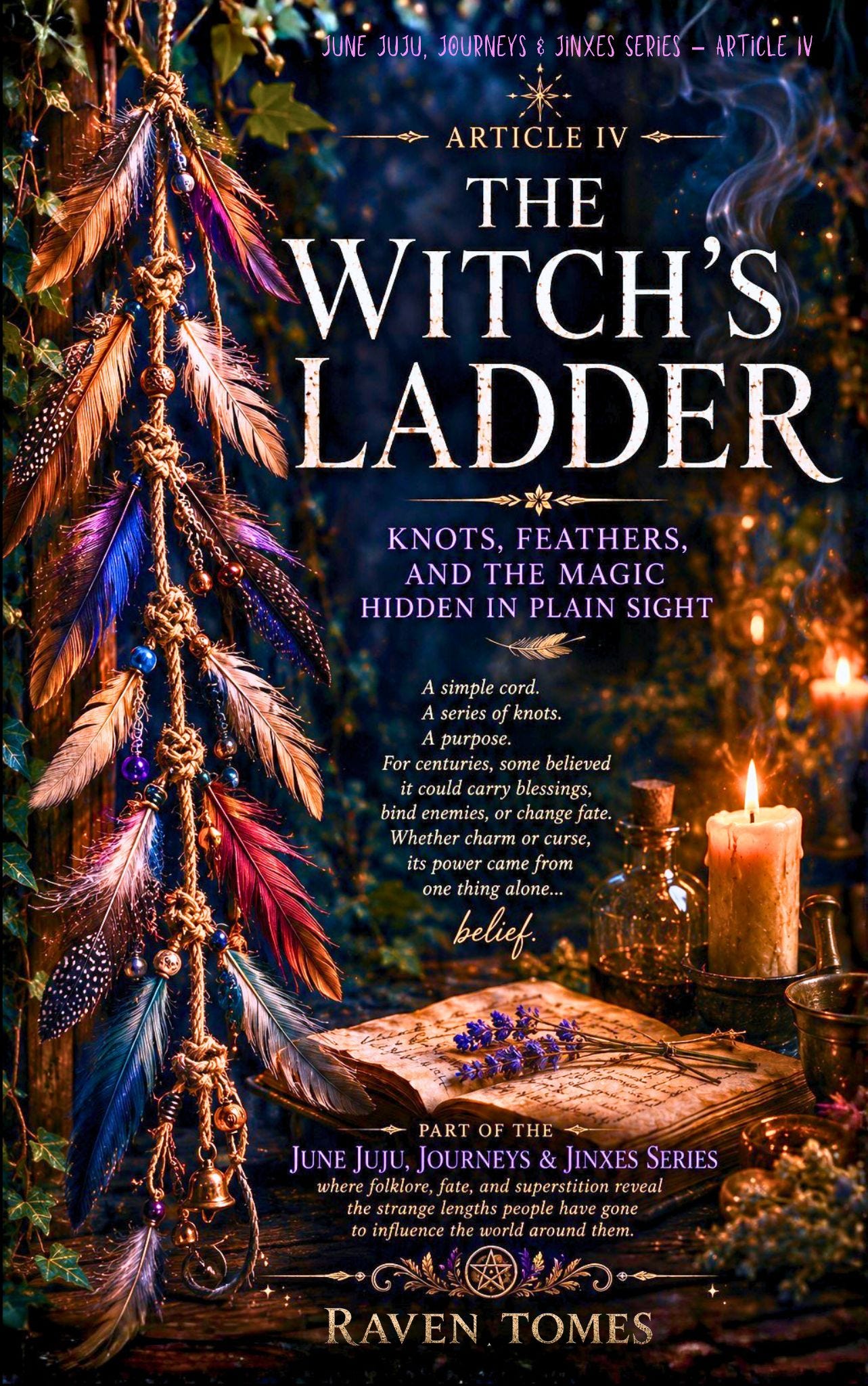
Part of the June JuJu, Journeys & Jinxes Series, where folklore, fate, and superstition reveal the strange lengths people have gone to influence the world around them.
By Raven Tomes
✨Knots, Feathers, and the Magic Hidden in Plain Sight
For centuries, people have hidden their fears in ordinary objects.
A charm tucked into a pocket.
A horseshoe above a doorway.
A bundle of herbs hanging near a window.
Most appear harmless.
That is often the point.
The Witch's Ladder looked like little more than a length of cord decorated with feathers and knots.
Yet for generations, whispers followed it.
Some claimed it could carry blessings.
Others insisted it could carry curses.
And many believed the difference depended entirely on the hands that made it.
The first widely known Witch's Ladder was reportedly discovered in the attic of an old English home during the nineteenth century. To the untrained eye, it appeared unremarkable—a cord woven with feathers and tied with numerous knots. Local folklore quickly supplied an explanation.
It was witchcraft.
Each knot, believers claimed, contained intention.
A wish.
A prayer.
A curse.
A fragment of will bound into physical form.
The concept was hardly unique to Britain. Across cultures and centuries, people have tied knots to represent promises, protection, luck, fertility, love, or revenge. Sailors purchased "wind knots" said to release favorable breezes. Lovers exchanged cords meant to bind affection. Folk practitioners crafted elaborate charms designed to influence fortune.
The Witch's Ladder occupied a stranger place.
It existed somewhere between prayer and spell.
Between craft and ritual.
Between superstition and belief.
Traditionally, the maker tied a series of knots while focusing on a specific intention. Feathers, beads, charms, or personal items might be woven into the cord. Some ladders were created for protection. Others for healing. Some supposedly carried wishes into the world.
And a few were said to carry something darker.
Fear has always transformed ordinary objects into powerful symbols.
A doll becomes haunted.
A mirror becomes cursed.
A ladder becomes evidence of unseen forces.
The object itself rarely changes.
Only the story attached to it.
That story is often enough.
Because belief has consequences.
A charm believed to provide courage may genuinely help someone face uncertainty. A curse believed to bring misfortune can turn every setback into proof that dark forces are at work.
The Witch's Ladder survives because it sits at the center of that tension.
Was it magic?
Was it psychology?
Was it folklore attempting to explain the unexplainable?
No one knows.What we do know is that people continue making them.
Even today.
Modern practitioners often create Witch's Ladders as tools for meditation, manifestation, prayer, remembrance, or personal reflection. What was once feared as evidence of witchcraft has become, for many, a symbol of focused intention.
The knots remain.
The feathers remain.
Only the interpretation has changed.
Perhaps that is the true lesson hidden within the Witch's Ladder.
Magic has never been solely about power.
It has always been about belief.
About taking something invisible and giving it shape.
A fear.
A hope.
A promise.
A prayer.
The ladder itself may possess no supernatural ability whatsoever.
Yet countless generations have looked at a cord filled with knots and seen something more.
And sometimes that is all folklore has ever been.
A collection of ordinary objects carrying extraordinary stories.
✨ ✨ ✨
Coming Tomorrow
🛤 Article V — The Ghost Roads of Britain
The Highways That Refuse to Stay Empty
For centuries, travelers have reported phantom hitchhikers, disappearing coaches, and spectral figures wandering lonely roads long after their deaths.