The Witch Bottle
The Household Guardian Buried Beneath the Hearth

Article XXV
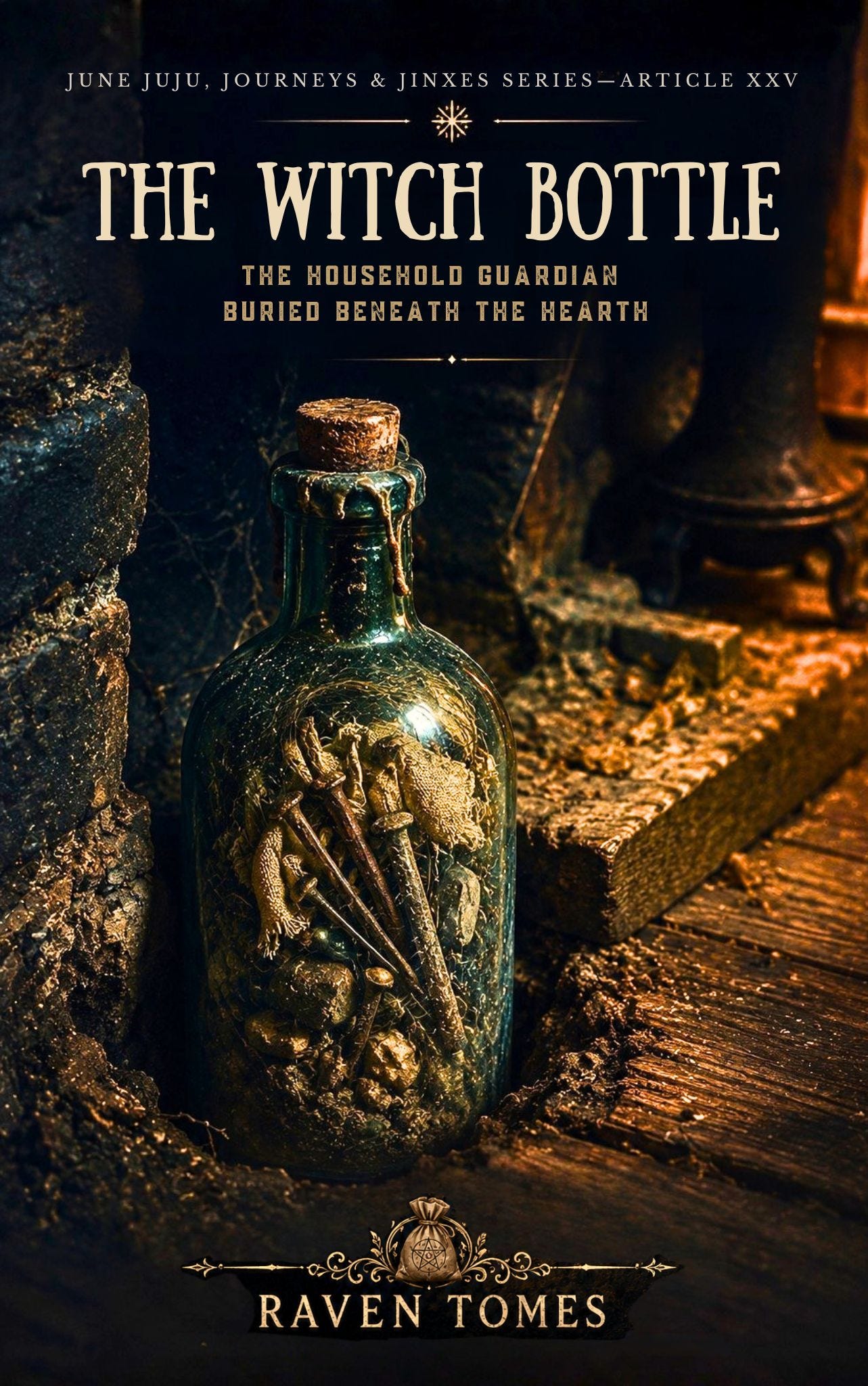
Part of the June JuJu, Journeys & Jinxes Series, where folklore, fate, and superstition reveal the strange lengths people have gone to influence the world around them.
By Raven Tomes
Some forms of protection were meant to be seen.
A horseshoe above the door.
A sprig of St. John's Wort hanging from a window.
A protective symbol carved into a beam.
Others were never intended to be found.
For centuries, families across England and parts of Europe secretly buried strange bottles beneath their homes, fireplaces, thresholds, and barns. Hidden from neighbors and forgotten by later generations, these objects were believed to do something remarkably important.
Catch evil before it reached the family.
Today they are known as Witch Bottles.
Archaeologists continue to discover them beneath centuries-old buildings, often sealed exactly where their owners intended them to remain. Most contain an assortment of peculiar items: bent nails, rusted pins, broken glass, herbs, hair, fingernail clippings, scraps of cloth, or even human urine.
To modern eyes, they appear unsettling. To the people who buried them, they represented security.
The belief was surprisingly simple.
If someone attempted to curse your household, the harmful magic would be drawn toward the bottle instead of the family. Once trapped inside, the curse could no longer reach its intended victims. In some traditions, the objects sealed within the bottle were believed to torment the witch responsible until the spell was broken.
Protection and retaliation existed side by side. The bottle defended the home. It also warned anyone who wished the household harm.
Most Witch Bottles were never displayed. Unlike charms worn around the neck or symbols carved above a doorway, these protections worked best when hidden. They were quietly placed beneath hearthstones, inside walls, beneath thresholds, or buried near entrances where unseen dangers were believed to cross into the home.
The protection was invisible…and was precisely the point. Perhaps that is why so many continue to be discovered centuries later.
Construction crews renovating old cottages occasionally uncover sealed glass bottles beneath fireplaces. Archaeologists excavating colonial settlements in North America have unearthed similar objects hidden beneath foundations. Even today, each discovery reminds us that ordinary families once invested extraordinary faith in rituals designed to guard against unseen threats.
Were the bottles magical?
Probably not.
Did the families believe they were?
Absolutely.
That distinction matters.
Protective folklore has never been solely about defeating evil. It is about reducing uncertainty.
Storms cannot be controlled.
Illness cannot always be prevented.
Misfortune arrives without permission.
People create rituals because rituals offer the comforting illusion that something can still be done.
A prayer.
A blessing.
A charm.
A buried bottle no one else will ever know exists.
The object itself becomes less important than the hope it represents. Perhaps that is why Witch Bottles continue to fascinate historians and paranormal enthusiasts alike.
Unlike many cursed objects, they were never intended to cause harm. They existed to stop it. To stand quietly between a family and whatever darkness might have been searching for a way inside.
Whether curses were real is ultimately beside the point. Fear certainly was. Hope was. And for generations, hope was sometimes poured into a simple glass bottle, sealed with wax, buried beneath the hearth, and trusted to guard a home long after the people who buried it had been forgotten.
Perhaps that is the greatest irony of all.
The families disappeared.
The houses changed hands.
Entire villages rose and fell.
Yet the bottles remained exactly where they had been placed.
Still waiting.
Still guarding.
Just in case something was still trying to get in.
✨ ✨ ✨
Coming Tomorrow
🛤 Article XXVI — The Devil's Highway
The Road Where Too Many Travelers Vanished
Long stretches of highway have always inspired stories, but few roads have earned a reputation as unsettling as the isolated highways where travelers seem to disappear without explanation.