
Article IX
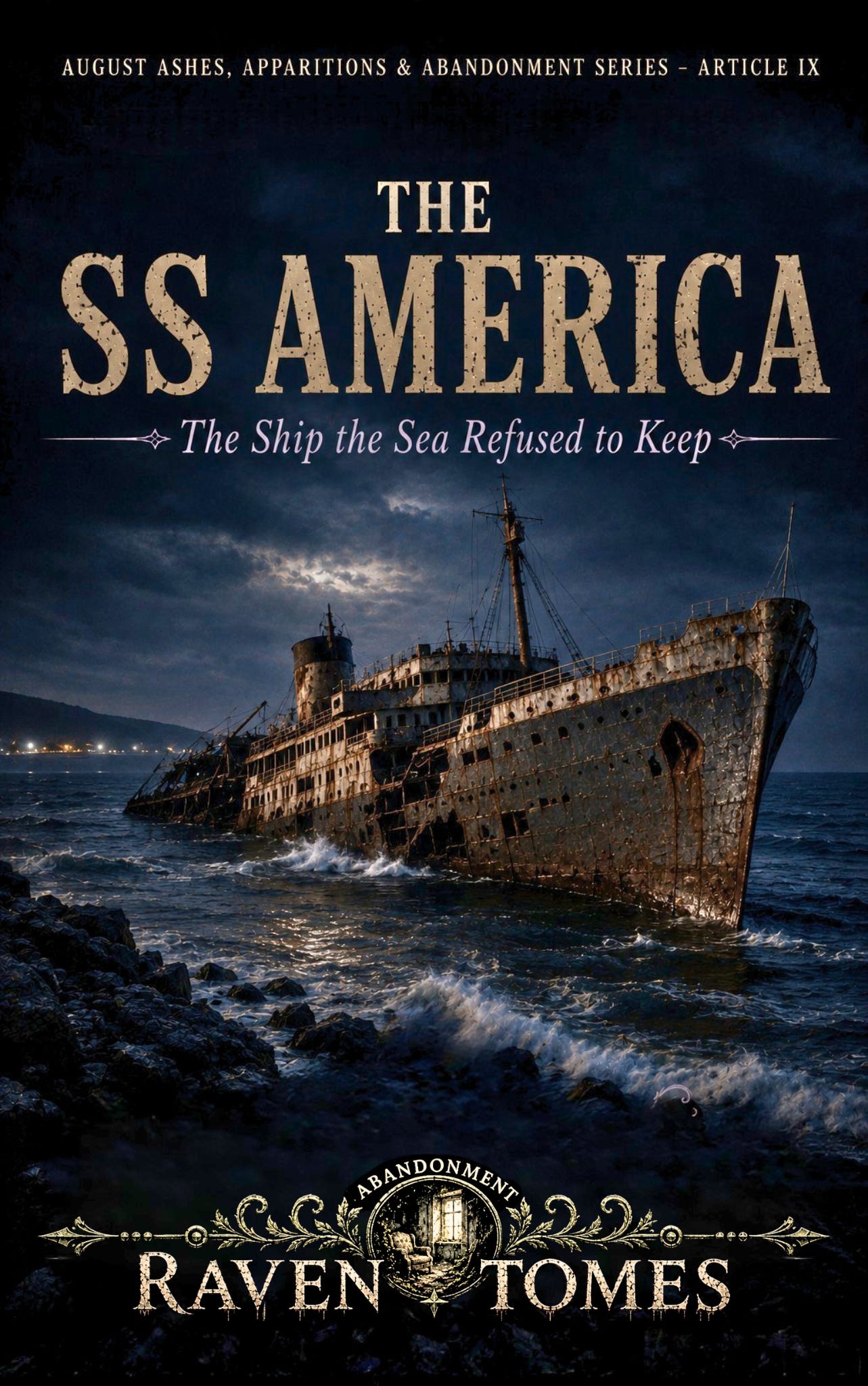
Part of the "August Ashes, Apparitions & Abandonment" Series, where every ember tells a story, every shadow lingers, and every forgotten place remembers.
By Raven Tomes
She was built to cross oceans. Instead...she spent her final years dying within sight of shore.
Long before rust consumed her decks and Atlantic waves tore through her hull, the SS America had been something magnificent.
She carried passengers across the Atlantic. She carried soldiers through war. And changed names, owners, flags, and purposes more times than most ships ever survive.
For more than half a century, she refused to disappear.
Then, in January 1994, the ocean finally took her.
Almost.
The story of the SS America began during an uncertain moment in history.
Launched on August 31, 1939—just days before Germany invaded Poland and the Second World War began—the ocean liner had been built for the United States Lines at Newport News Shipbuilding in Virginia.
She was approximately 723 feet long, displaced more than 35,000 tons when fully loaded, and was designed to carry more than 1,200 passengers in three classes.
Her interiors were elegant without being excessively extravagant. Dining rooms gleamed beneath carefully designed lighting. Passengers gathered in lounges decorated for transatlantic travel. Cabins awaited travelers preparing to cross an ocean that was becoming more dangerous by the day.
The ship entered commercial service in August 1940. But war was already reshaping the Atlantic.
To make her American neutrality unmistakable, enormous United States flags were painted on her hull along with the name AMERICA in lettering visible from a considerable distance.
It would not protect her civilian career for long.
After the United States entered World War II, the liner was requisitioned by the U.S. Navy in 1941. Her name changed. The SS America became the USS West Point.
Luxury gave way to necessity. Elegant passenger spaces were altered to accommodate thousands of troops. Instead of vacationers and businessmen crossing the Atlantic, soldiers crowded aboard carrying uniforms, weapons, orders, and uncertainty.
During the war, West Point reportedly transported more than 350,000 military personnel and traveled hundreds of thousands of miles through dangerous waters.
She crossed oceans threatened by submarines. She sailed in convoys. Transported troops to theaters of war across the world. And she survived.
When peace finally returned, so did her original name. America became a passenger liner once again in 1946.
For years, she resumed transatlantic service between the United States and Europe, sailing alongside a new generation of increasingly sophisticated ocean liners.
But the world was changing. Aircraft were becoming faster. Commercial aviation was becoming affordable.
A journey that once required days at sea could soon be completed in hours. Ocean liners that had once represented the height of international travel began losing passengers to the sky.
America changed with the times as long as she could.
In 1964, she was sold to the Greek-owned Chandris Group and renamed Australis.
Under her new identity, she carried emigrants and travelers between Europe, Australia, and New Zealand. Thousands of passengers began new lives after crossing oceans aboard her.
For many families...Australis was not simply transportation. She was the bridge between one life and another. But ships age. Machinery wears down. Operating costs rise. Newer vessels replace old ones.
By the late twentieth century, the former America had become a ship searching for a purpose. She changed owners repeatedly. Her names changed with them.
America.
West Point.
America again.
Australis.
Italis.
Noga.
Alferdoss.
And eventually...American Star.
Each name represented another attempt to keep the old liner alive. Some plans imagined her as a floating hotel. Others envisioned a permanently moored tourist attraction.
By the early 1990s, she had been purchased with the intention of transforming her into a five-star hotel in Thailand.
The plan was ambitious. The ship was old. Her engines were no longer operational. She would have to be towed.
In December 1993, American Star left Greece under tow by the tugboat Neftegaz 67.
She would never reach Thailand. While crossing the Atlantic in January 1994, the vessels encountered severe weather near the Canary Islands. The tow lines failed. Crews attempted desperately to reconnect them. The sea refused.
For days, the powerless liner drifted through the Atlantic. There were no functioning engines to turn her away from danger. No passengers stood at the railings. No captain could order enough power to escape the approaching coastline.
A ship that had crossed oceans for more than fifty years...could do nothing but drift.
On January 18, 1994, American Star ran aground off the western coast of Fuerteventura in the Canary Islands. The location could hardly have been worse. Powerful Atlantic waves struck her broadside. Salvage crews initially hoped the vessel might be recovered once the weather improved.
It never happened.
Within approximately forty-eight hours, the relentless surf broke the ship in two. The stern section collapsed and disappeared beneath the waves relatively quickly. The bow remained. And that was when American Star became something else.
Not a liner.
Not a hotel.
Not even truly a ship anymore.
A ruin.
For years, the enormous bow stood stranded offshore like the remains of some industrial creature that had crawled from the Atlantic and died before reaching land.
Rust spread across the hull. Windows disappeared. Decks collapsed. Waves entered rooms where passengers had once eaten dinner beneath polished lights. The sea moved freely through corridors built to keep it outside. Photographers came. Tourists came. Urban explorers came.
The wreck became one of Fuerteventura's strangest landmarks.
From shore, American Star looked almost impossible. An ocean liner belonged in a harbor. Or moving across the horizon.
It was not supposed to sit broken in shallow water while waves passed through its body. The wreck attracted adventurous visitors despite the obvious danger. Some reportedly swam or used small boats to reach it. Entering the deteriorating structure was extraordinarily hazardous. Corroded metal, unstable decks, violent surf, and underwater debris made the wreck unpredictable.
The ship continued collapsing regardless of who came to see her.
Storm after storm removed another piece.
By 2005, much of the remaining structure had deteriorated significantly.
In 2006, the bow finally collapsed onto its side.
The Atlantic continued dismantling what remained.
By the end of the decade, most of the wreck had disappeared beneath the water.
Today, little remains visible above the surface.
The SS America is almost entirely gone.
But photographs preserve the years when she stood broken off Fuerteventura.
And perhaps that is why her final chapter remains so compelling.
Abandoned buildings decay slowly.
Trees grow through floors.
Roofs collapse.
Walls surrender brick by brick.
A shipwreck is different.
The thing destroying it never stops moving.
Every wave takes something.
Every tide reaches farther inside.
Every storm changes the shape of what remains.
The ocean does not preserve abandonment.
It consumes it.
There are stories, naturally, about the wreck.
Visitors described strange sounds carried across the water.
Metal groaning when the sea was calm.
Lights where no electricity remained.
Shadowed shapes inside broken windows.
Such stories are difficult to separate from the natural sounds of a deteriorating steel ship being struck continuously by the Atlantic.
Metal bends.
Wind moves through corridors.
Waves crash inside hollow spaces.
A wreck can make extraordinary noises without requiring anything supernatural.
But perhaps American Star never needed ghosts.
Her history was haunting enough.
Thousands of soldiers once slept within her hull while traveling toward a war they might not survive.
Immigrants stood on her decks watching old countries disappear behind them.
Families crossed oceans toward lives they had never seen.
Passengers danced.
Children explored corridors.
Crew members worked through countless nights while the Atlantic passed beyond the windows.
For more than fifty years...
The ship carried people somewhere.
Then came the final voyage.
No passengers.
No destination she would ever reach.
Only a towline...
A storm...
And a coastline growing closer.
There is something almost cruel about the place where America died.
She survived the Second World War.
She survived decades of Atlantic crossings.
She survived changing technology, changing owners, changing nations, and changing names.
She crossed oceans again and again.
Yet her final journey ended within a few hundred feet of land.
For years afterward, anyone standing on the beach could see her.
Close enough to recognize the windows.
Close enough to imagine walking her decks. Close enough to believe she might somehow be saved.
But abandonment is not always about distance. Sometimes…something can be right in front of us and still be beyond rescue. The waves kept coming. The steel kept surrendering. And eventually the ship the ocean had carried for more than half a century became part of it.
🏚🍂⏳
Coming Tomorrow...
🔥 Article X — The Bazar de la Charité Fire
Paris gathered beneath one roof for an afternoon of charity, elegance, and entertainment.
Then a new invention caught fire...and within minutes, the fashionable bazaar became a death trap.
"Some stories don't end here.
Until then... stay curious."
— Raven Tomes 🖤🐦⬛