The Selkie's Skin
What Was Stolen Could Never Return

Article XIV
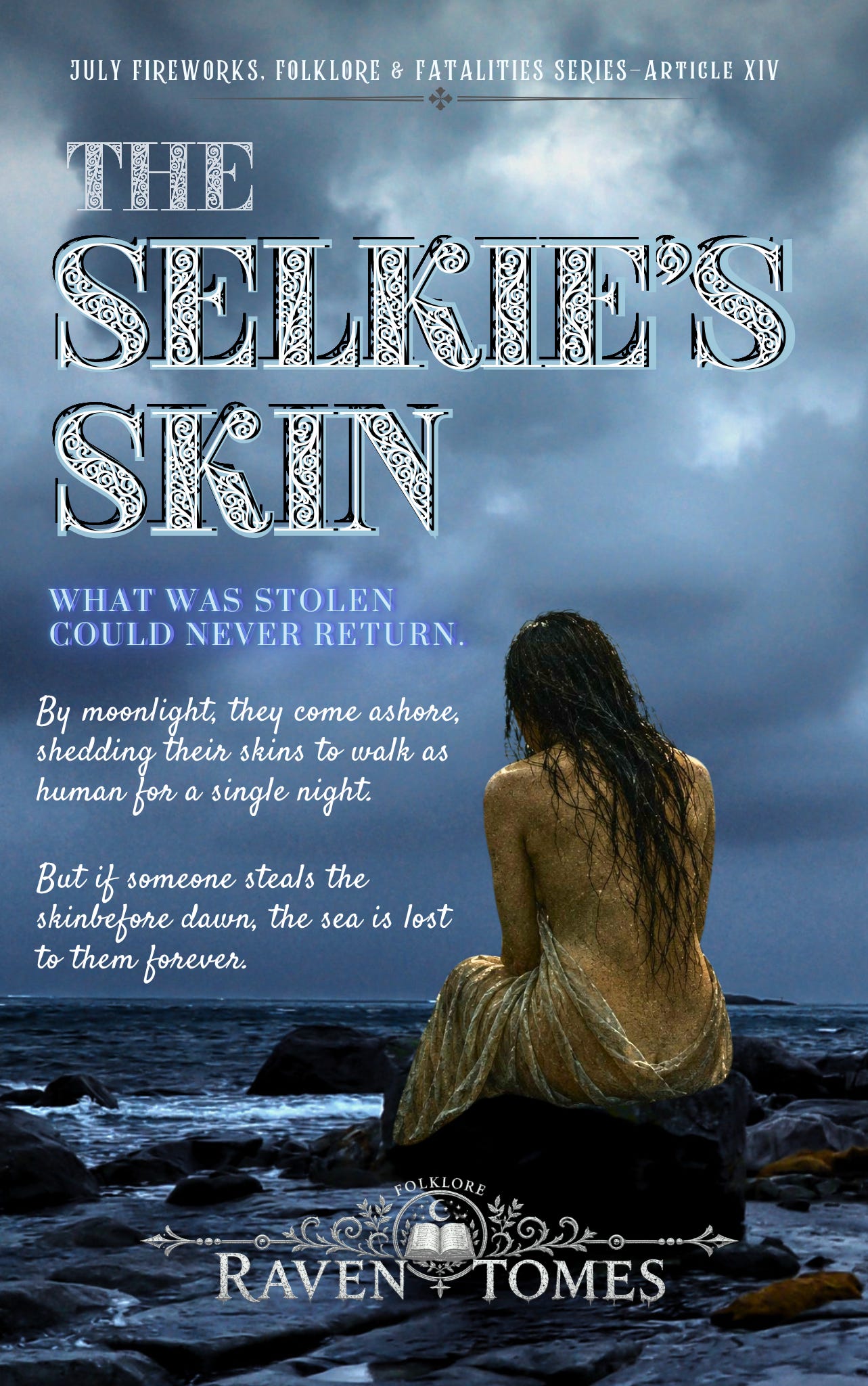
Part of the "July Fireworks, Folklore & Fatalities" Series, where every celebration casts a shadow, every legend hides a truth, and every tragedy leaves an echo history cannot silence.
By Raven Tomes
Along the rocky shores of Scotland, Ireland, and the Faroe Islands, fishermen once avoided looking too closely at the seals resting upon lonely beaches.
Not because they feared the animals. Because they feared what they might become.
For centuries, stories whispered of selkies—beings who lived as seals beneath the sea but could shed their skins beneath the light of the full moon to walk upon land as men and women. They laughed. They danced. They sang with voices said to rival the tide itself.
But dawn always carried a single rule. Before sunrise, they had to find their sealskin.Without it...they could never return home. The oldest stories rarely describe the selkies as monsters. If anything, they are heartbreak given form.
One of the most enduring legends tells of a lonely fisherman who discovered a beautiful woman dancing upon the shore beneath the moon. Hidden among the rocks lay the sealskin she had shed before stepping onto land. Rather than leaving it where it belonged, he concealed it.
When dawn arrived, she searched every rock along the shoreline.
She overturned driftwood.
She called into the wind.
She clawed through the sand until her hands bled.
Her sealskin was gone.
With it...went the sea.
Unable to return home, she became the fisherman's wife. Together they raised children. By every outward appearance, they built a peaceful life.
Yet every telling of the legend describes her the same way. Whenever the tide rolled in...she looked toward the horizon.
She smiled.
She laughed.
She loved her children.
But some part of her remained beyond the waves.
Years later—sometimes decades—the hidden sealskin is discovered inside an attic chest, beneath loose floorboards, or tucked away behind a stone hearth. The moment her fingers touch it, she hesitates only long enough to look once at the family she has come to love.
Then she walks back to the sea snd never returns.
To modern readers, the tale feels less like fantasy than tragedy. What once sounded romantic now carries the unmistakable weight of captivity. The selkie did not choose to stay. She simply learned how to survive without the only thing that had ever made her free.
Other stories speak of male selkies whose haunting songs drew lonely women toward the sea, or of children born with faint webs between their fingers and an unshakable longing for the waves. Fishermen claimed certain seals watched them with almost human sorrow, while mothers warned children never to steal what belonged to the sea. Not because it was cursed. Because it was someone's way home.
Folklore often reveals more about the people telling the stories than the creatures themselves.
Life along the northern coast was unforgiving. The sea provided food, yet claimed countless lives without warning. Storms stole husbands. Waves carried away sons and daughters. Entire boats disappeared beyond the horizon, leaving families with no answers and no bodies to bury.
The selkie offered another possibility. Perhaps those who vanished had not been taken.
Perhaps they had simply gone home. It is a gentler explanation than grief. Yet the stories never truly comfort. Every version carries the same quiet ache.
Something precious has been separated from where it belongs.
Someone waits beside a shore that will never answer.
Even today, seals possess an unsettling quality. Their large, dark eyes seem almost human. They watch silently from the surf before slipping beneath the waves, leaving only ripples behind.
Long enough to make you wonder. What if the old stories remembered something we've forgotten?
Perhaps that is why the legend has endured for centuries.
Not because anyone truly believes seals become people beneath the moon. But because everyone understands what it feels like to lose the place where they belong.
The sea keeps many secrets.
Perhaps the greatest among them is not what lives beneath the waves...But who still longs to return.
And the next time a seal raises its head above the surf...try not to wonder whether it's simply watching the shore...or searching for the skin someone stole centuries ago.
📖🌙🕯
Coming Tomorrow...
☠️ Article XV — The Byford Dolphin Accident
"A routine dive became one of the most catastrophic industrial accidents ever recorded. What happened in a fraction of a second forever changed the way deep-sea divers work beneath the ocean."
“Some stories don't end here.
Until then... stay curious.”
— Raven Tomes 🖤🐦⬛