The Number 39
The Number an Entire Nation Learned to Fear

Article XXVII
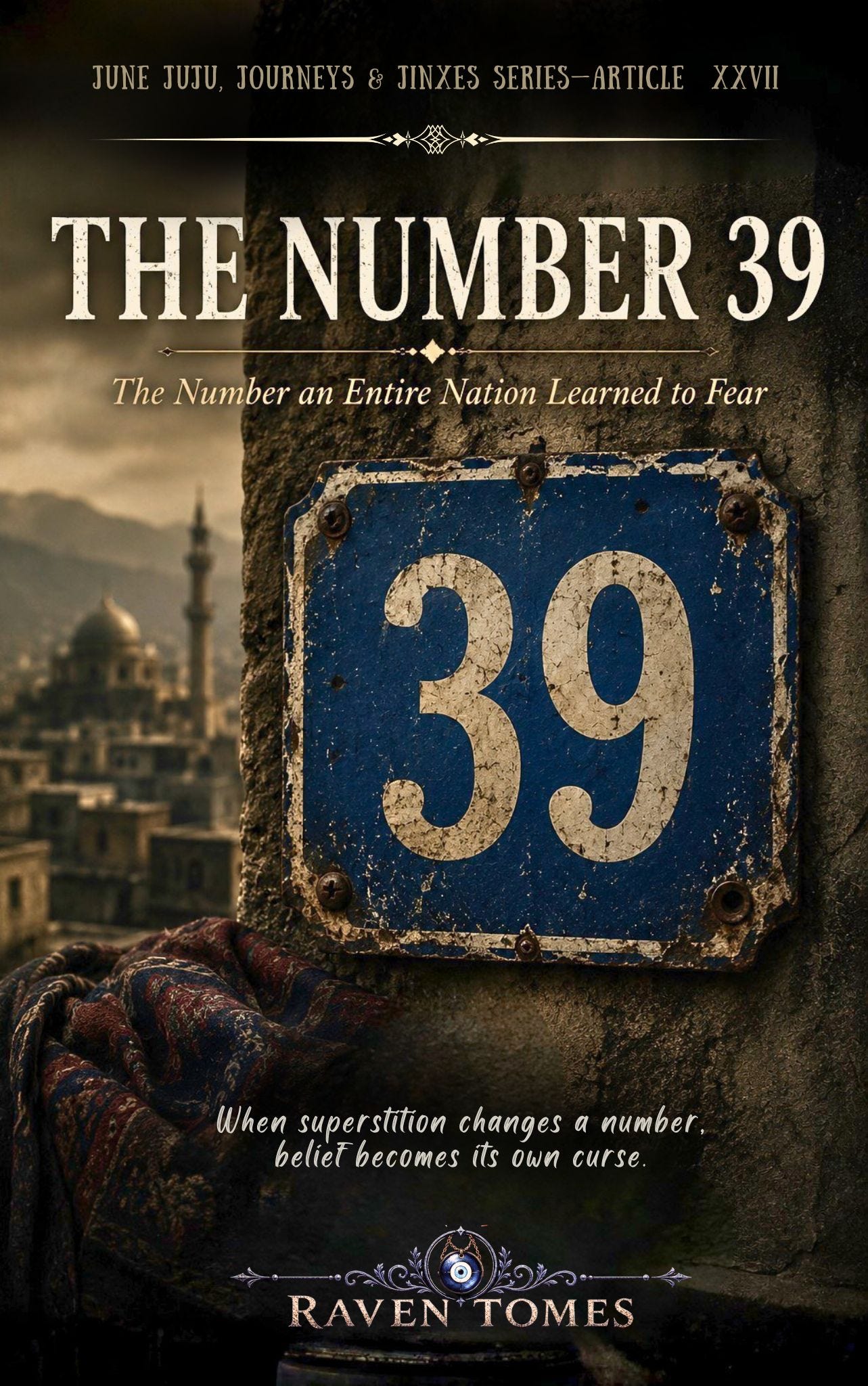
Part of the June JuJu, Journeys & Jinxes Series, where folklore, fate, and superstition reveal the strange lengths people have gone to influence the world around them.
By Raven Tomes
Most people have a number they consider lucky.
A birthday.
An anniversary.
A jersey worn by a favorite athlete.
Some carry those numbers through life without ever questioning why they matter. Others spend remarkable amounts of time avoiding a different kind of number altogether.
In many Western countries, that number is thirteen.
Buildings quietly skip the thirteenth floor. Airlines avoid labeling certain rows. Hotels replace one number with another in the hope that guests will sleep a little easier.
Superstition, it seems, has always found a way into architecture. Yet thirteen is hardly universal. Travel far enough, and entirely different numbers become the objects of fear.
In Japan, the number four is often avoided because its pronunciation closely resembles the word for death.
In parts of China, the number fourteen combines sounds associated with certain death, making it even more unsettling.
And in Afghanistan, one number has acquired a reputation so unusual that it transformed from an ordinary number into something people actively erase from their lives.
Thirty-nine….At first glance, there is nothing remarkable about it.
It sits quietly between thirty-eight and forty, carrying no obvious mathematical significance and no ancient religious symbolism that distinguishes it from the numbers surrounding it.
Its reputation emerged for a very different reason.
For years, rumors circulated that the number had become associated with prostitution and organized crime, particularly in the city of Kabul. Stories spread of an infamous individual whose vehicle bore the number thirty-nine and whose wealth was tied to exploitation and vice. Whether those stories were entirely accurate became almost irrelevant.
The association itself was enough. As the rumors spread, the number began to take on a life of its own.
People reportedly paid large sums of money to avoid license plates ending in thirty-nine. Phone numbers were changed. House numbers were altered. Businesses quietly removed it wherever possible. To be connected with the number invited ridicule, suspicion, or unwanted attention.
Eventually, the fear no longer depended upon knowing the original story. Most superstitions reach that point.
The explanation fades.
The behavior remains.
Children inherit it from parents.
Neighbors reinforce it.
Communities accept it without asking whether the belief still serves any purpose.
The number becomes untouchable simply because everyone agrees that it should be. Psychologists have long recognized this pattern.
Human beings are exceptionally skilled at attaching meaning to symbols. Once enough people repeat the same association, coincidence begins to resemble evidence. Every unfortunate event strengthens the belief, while every ordinary day quietly disappears from memory.
The mind remembers what confirms the story. It forgets everything else. That tendency has shaped folklore for centuries.
A black cat crosses the road before an accident.
A particular tree seems cursed because lightning struck it twice.
A family refuses to move into a house after hearing what happened to the previous occupants.
The object itself changes very little. Our perception changes everything. Yet there is another reason number superstitions endure.
Numbers appear objective. Unlike stories or rumors, they seem fixed and dependable. We assign them to homes, vehicles, hotel rooms, flights, lottery tickets, and important dates. They become woven into daily life so completely that avoiding one can feel like altering reality itself.
Perhaps that is why feared numbers possess such unusual power.
You cannot argue with them.
You simply encounter them.
Or avoid them.
In Afghanistan, thirty-nine became less than a number and more than a warning.
Not because mathematics had changed.But because belief had. The most fascinating aspect of the story is not whether the superstition is true. It is how thoroughly an ordinary number came to influence ordinary lives.
Doors were renumbered.
Documents revised.
Money exchanged.
Decisions altered.
All because two digits, placed side by side, acquired a meaning no one wanted attached to their name.
Perhaps every culture has its own version of thirty-nine.
A word never spoken.
A place quietly avoided.
A symbol everyone recognizes but few can fully explain.
Superstitions rarely survive because they make sense. They survive because enough people decide it is safer not to test them.
After all, changing a number is easy. Living with the possibility that everyone else might be right...is much harder.
🧿 🧿 🧿
Coming Tomorrow
🧿 Article XXVIII — The Dybbuk Box
The Cabinet Said to Hold Something That Never Left
An old wine cabinet purchased at an estate sale became the center of one of the most infamous paranormal legends of the modern era. Whether haunted, misunderstood, or fueled by belief alone, the Dybbuk Box raises an unsettling question:
Can an ordinary object become dangerous simply because enough people believe it is?
Fascinating!
Comedian Jack Benny always claimed his true age was 39- at first I thought it was a vanity thing, but there's clearly something else to it.