The Hope Diamond
Article VI

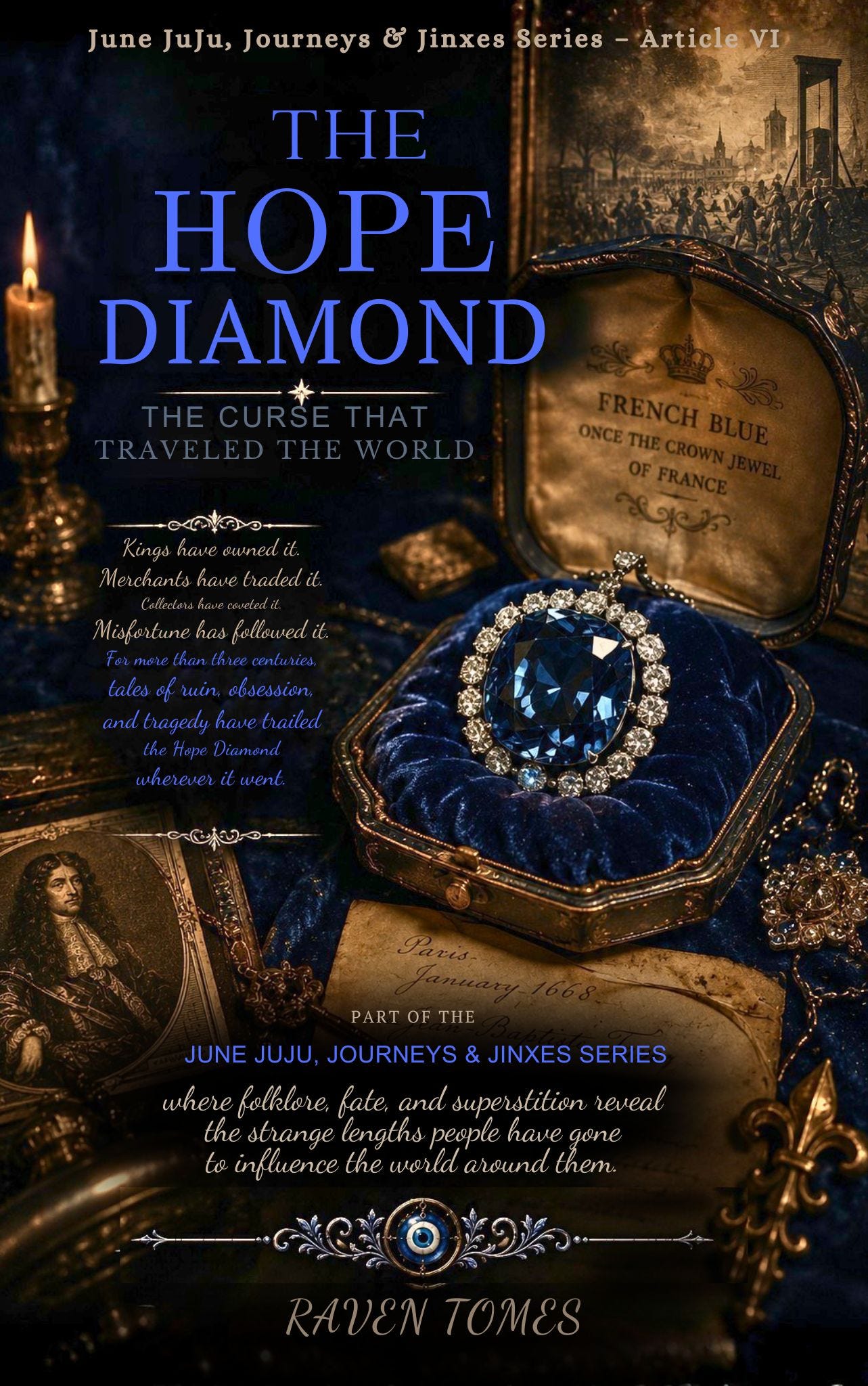
Part of the June JuJu, Journeys & Jinxes Series, where folklore, fate, and superstition reveal the strange lengths people have gone to influence the world around them.
By Raven Tomes
The Curse That Traveled the World.
Few curses have traveled farther than the Hope Diamond.
Kings have possessed it.
Merchants have traded it.
Collectors have coveted it.
Museums have displayed it.
And for more than three centuries, stories have followed it wherever it went.
Stories of ruin.
Stories of obsession.
Stories of death.
The diamond itself is breathtaking.
Deep blue and impossibly rare, it weighs more than forty-five carats and remains one of the most famous gemstones in the world. Visitors stand before it in silent admiration, their attention captured by a stone that seems almost too perfect to exist.
Yet the Hope Diamond's reputation was never built on beauty alone.
It was built on misfortune.
According to legend, the diamond originated in India, where it was allegedly stolen from a sacred temple. Some versions of the story claim it adorned a statue of a deity. Others suggest it was protected by priests who warned that disaster would befall anyone who removed it.
Whether those stories are true remains uncertain.
What is certain is that tales of tragedy began accumulating almost immediately.
The French gem merchant Jean-Baptiste Tavernier acquired the stone during the seventeenth century. Later retellings claimed he met a gruesome end after bringing the gem to Europe. Historians dispute those accounts, yet the story endured.
Then came royalty.
King Louis XIV purchased the diamond and had it recut into a magnificent jewel known as the French Blue.
For a time, it glittered among the wealthiest treasures in Europe.
Then history intervened.
The French Revolution swept through the country, bringing chaos, imprisonment, and execution.
Louis XVI was beheaded.
Marie Antoinette followed.
The crown jewels disappeared.
And somewhere amid the upheaval, the famous blue diamond vanished.
When it resurfaced years later, it had been altered.
Smaller.
Recut.
Different.
Yet unmistakably the same stone.
The curse survived the transformation.
Over the centuries, owners reportedly encountered bankruptcies, scandals, ruined marriages, illnesses, accidents, and untimely deaths. Some stories can be verified. Others have grown larger with every retelling. Separating fact from folklore has become nearly impossible.
The list itself is part of the legend.
A wealthy collector suffers financial ruin.
A socialite faces tragedy.
A businessman loses everything.
Another owner dies unexpectedly.
Coincidence becomes pattern.
Pattern becomes reputation.
Reputation becomes curse.
That progression appears again and again throughout history.
Humans are natural storytellers.
We search for connections.
We seek causes for suffering.
Randomness feels unsatisfying.
A curse provides an explanation.
A narrative.
A villain.
The Hope Diamond offered all three.
The larger the legend became, the more every future tragedy seemed destined to reinforce it.
And perhaps that is the strangest aspect of all.
The curse may owe its survival not to supernatural forces, but to human nature itself.
Once people expect disaster, they begin noticing every example that supports the belief. Failures are remembered. Successes are forgotten. Coincidences become evidence.
The story grows stronger.
The curse grows stronger.
Whether the diamond deserves its reputation is almost beside the point.
Today, the Hope Diamond resides safely behind glass, visited by millions each year.
People stare.
Photographs are taken.
Children press against display cases.
No catastrophe follows.
Yet visitors still ask the same question.
What if the stories are true?
That question has followed the diamond across continents, through revolutions, fortunes, and generations.
Not because people believe a gemstone can control fate.
But because everyone wonders whether luck can.
Perhaps that is why cursed objects continue to fascinate us.
They transform misfortune into mystery.
They suggest that tragedy follows rules.
That bad luck has a source.
That suffering can be explained.
The Hope Diamond offers no proof of any curse.
Only stories.
Yet stories have always possessed a strange power of their own.
And few stories have traveled farther than this one.
🧿 🧿 🧿
Coming Tomorrow
✨ Article VII — Goofer Dust & Graveyard Dirt
The Powders Said to Carry Fortune, Protection, and Revenge
Long before modern superstition, folk practitioners across the American South used strange powders gathered from crossroads, cemeteries, and sacred ground.