
Article VIII
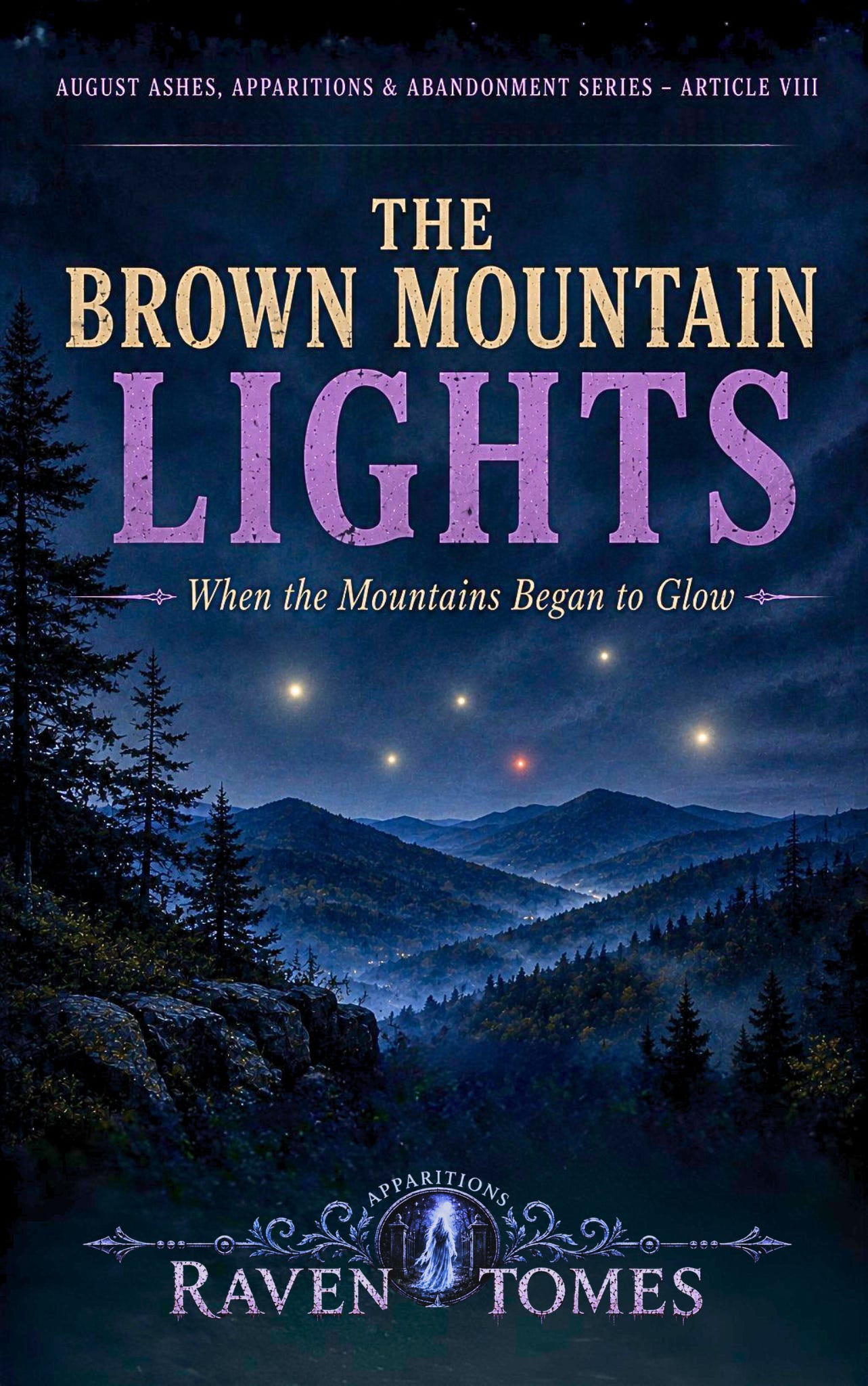
Part of the "August Ashes, Apparitions & Abandonment" Series, where every ember tells a story, every shadow lingers, and every forgotten place remembers.
By Raven Tomes
Long before anyone tried to explain the lights...people simply watched them.
They appeared above the mountains of western North Carolina after darkness settled across the valleys. Small points of light. White. Yellow. Sometimes reddish or orange. They hovered above the horizon, drifted through the darkness, disappeared without warning, and occasionally seemed to rise from the mountains themselves.
No road appeared beneath them. No house stood where they burned. And when someone tried to get closer, the lights were gone.
For generations, people have gathered along overlooks in the Blue Ridge Mountains hoping to witness what became known as the Brown Mountain Lights. Some leave disappointed. Others leave with photographs. A few leave convinced they have seen something no explanation has ever completely settled.
Brown Mountain itself rises approximately 2,600 feet above sea level in the Pisgah National Forest of western North Carolina, near the communities of Morganton and Linville. The elongated ridge is not among the tallest or most dramatic mountains in the region.
Yet after sunset. People look toward it.
Stories of unexplained lights around Brown Mountain stretch back well over a century. Newspaper reports helped bring the phenomenon wider attention in the early twentieth century, particularly after unusual lights were reported following a major flood in 1916 that disrupted rail service in the region.
The timing mattered. One popular explanation had been that observers were simply seeing locomotive headlights moving through distant valleys. When floods damaged railroad lines and reports of lights allegedly continued the mystery deepened.
Eventually, the United States government became interested. In 1922, the U.S. Geological Survey sent geologist George Rogers Mansfield to investigate the Brown Mountain Lights. It was not a paranormal investigation. Mansfield approached the reports as a scientist. He studied observation points. Mapped sight lines. Examined nearby roads and railroad routes while watcheing the mountain himself.
His conclusion was considerably less supernatural than the legends surrounding the lights.
Most of the reported phenomena, Mansfield argued, could be explained by ordinary sources viewed across considerable distances through the unusual geography and atmospheric conditions of the mountains. Automobile headlights. Train lights. Stationary electric lights. Brush fires. And stars or planets appearing near the horizon.
Mountain landscapes can deceive the eye remarkably well.
Distance becomes difficult to judge after dark. Layers of ridges flatten against one another. Atmospheric refraction can distort light. Temperature differences in the air can bend distant illumination, making something miles away appear to float above the landscape.
A car traveling along a distant road can become a wandering orb. A train disappearing behind trees can appear to blink out of existence. A star near the horizon can shimmer, change color, and seem to move.
Science had answers. The stories continued anyway.
Because the Brown Mountain Lights had already become something larger than an optical puzzle. They had become folklore.
One of the most enduring legends tells of a woman searching the mountains for a loved one who never returned. Depending upon who tells the story, she is a grieving mother searching for her missing child. A wife looking for her husband…or a young woman waiting for someone lost in the wilderness.
She carries a lantern through the darkness. She never finds the person she seeks. And somewhere along the mountain…she never stops searching.
Another tale reaches much further into the past.
According to a frequently repeated legend, the lights appeared after a great battle between Native peoples centuries before European settlement. The mysterious glow supposedly came from women carrying torches across the battlefield as they searched for fallen warriors.
It is a haunting story and is also one that should be treated carefully.
Reliable historical evidence supporting the specific battle described in modern versions of the legend is lacking, and many supernatural stories attributed to Indigenous traditions were recorded or popularized much later by non-Indigenous storytellers.
Folklore often borrows authority from age. Calling a story "ancient" makes it feel more mysterious. That does not necessarily make it true.
Another legend places the lights during the Civil War. Soldiers supposedly disappeared in the mountains, leaving loved ones to search for them by lantern light.
Again...Documentation is scarce. But the pattern remains remarkably consistent. Someone is lost. Someone searches. The light remains. Perhaps that is why the Brown Mountain Lights became such powerful folklore. Human beings have always understood the image of a light in the darkness.
It means someone is coming. Someone is waiting. Someone is trying to find the way home.
Scientific investigations did not end public interest.
During the twentieth century, thousands of visitors traveled into the region hoping to see the lights for themselves. Brown Mountain Overlook and Wiseman's View became popular observation points.
Witness descriptions vary dramatically. Some report distant stationary lights. Others describe glowing spheres rising above the ridge. Some claim the lights move sideways, change color, divide into multiple points, or disappear instantaneously. Photographs and videos occasionally surface. Most prove inconclusive. A distant light photographed at night rarely reveals where it originated.
That uncertainty has allowed almost every imaginable explanation to flourish.
Swamp gas.
Ball lightning.
Earthquake lights.
Electromagnetic activity.
Ghosts.
UFOs.
Even naturally occurring plasma has been proposed.
Some explanations are scientifically plausible under particular circumstances. Others belong firmly to folklore. None has transformed the Brown Mountain Lights into a single, clearly defined phenomenon.
That may be because there is no single phenomenon to explain. Some sightings almost certainly are headlights. Some are probably trains. Others may be stars, aircraft, atmospheric effects, campfires, or distant buildings.
And then there are the reports that witnesses insist behaved differently. Lights that seemed too high for roads. Lights moving in unexpected directions. Lights appearing where observers believed no ordinary source existed.
Those accounts keep the mystery alive.
Yet perhaps the most interesting thing about Brown Mountain is not whether every light can be explained. It is that people continue watching.
More than a century after scientists mapped the roads and traced the railways...people still park their cars along mountain overlooks after sunset. They switch off their headlights, stare toward a dark ridge and wait.
Sometimes nothing happens. The mountain remains exactly what geology says it is…
Rock.
Trees.
Shadow.
Then...A light appears. Far away. Small enough to dismiss. Bright enough to notice.
Perhaps it is a car turning along a road hidden behind the ridge. Perhaps it is a star distorted through layers of mountain air or someone is standing miles away beside a porch light without realizing that strangers across the valley are watching.
Or perhaps...for just a momoment…there is no answer.
Mysteries do not always survive because science fails. Sometimes they survive because explanations are less powerful than experience.
You can tell someone the light was a headlamp. You can map the road. Measure the distance. Calculate atmospheric refraction. Explain every reasonable possibility. But if that person stood alone beneath a dark Carolina sky and watched a light rise where they believed nothing should have been. They would feel something ancient stir in the silence.
The explanation may never replace the moment. That is where folklore lives. Not necessarily in what happened. But in what the experience meant to the person who witnessed it.
For generations, the Brown Mountain Lights have been called ghosts, lanterns, omens, illusions, and unexplained phenomena.
Perhaps they have been all of those things. Perhaps they have been none. The mountain offers no testimony. It simply waits for darkness. And somewhere beyond the trees...another light appears.
👻🌫️🕯️
Coming Tomorrow...
🏚 Article IX — The SS America
Once one of the great passenger liners of the Atlantic, she survived war, changing owners, and decades at sea.
Then she broke free from her tow and died alone against the rocks.
"Some stories don't end here.
Until then... stay curious."
— Raven Tomes 🖤🐦⬛
I especially liked the distinction near the end between explaining a phenomenon and explaining the experience of witnessing it. A headlight, a star, or atmospheric refraction may account for the light’s physical origin without erasing what that moment meant to the person watching. That is indeed where folklore lives.