Safe Enough to Sleep

May Mirth, Maladies & Manifestations — Article III
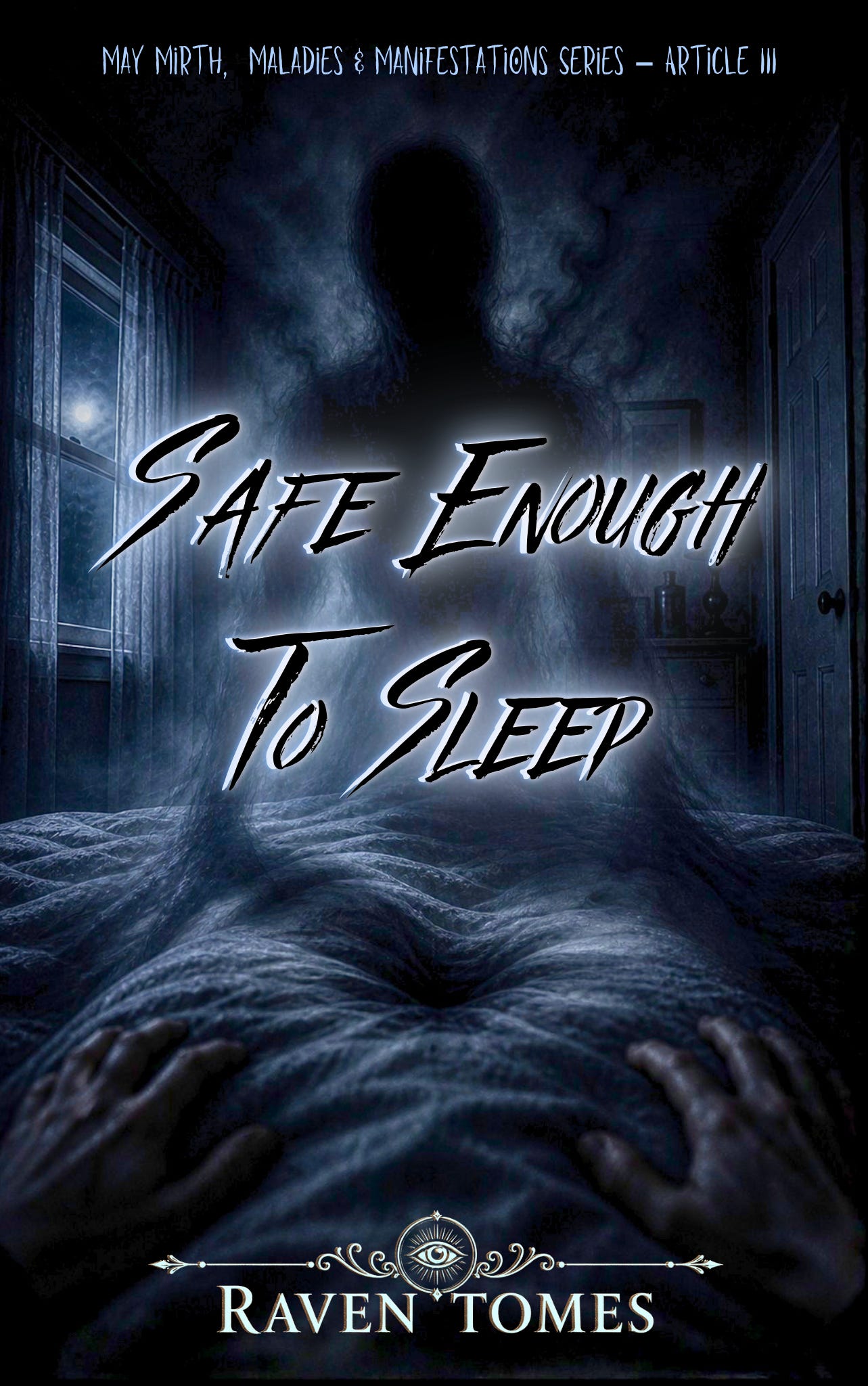
Part of the May Mirth, Maladies & Manifestations Series, where what’s celebrated, what’s suffered… and what’s seen are never the same thing.
By Raven Tomes
Doctors describe it in clinical terms.
A temporary paralysis that occurs when the body wakes before the mind has finished dreaming. The eyes can open. Awareness returns. The body does not respond.
They call it a disruption of REM sleep.
They note the symptoms with careful language. Inability to move. Pressure on the chest. A sense of presence in the room.
Most episodes last only seconds.
Most.
Accounts of it appear long before the terminology.
In parts of Europe, they called it the night hag. A figure that sat on the chest, pressing the breath from the body while the victim lay awake and unable to move. In Japan, it is known as kanashibari. In Newfoundland, the old hag. Different names, different places, the same description repeated with unsettling precision.
A body that will not move.
A presence that will not leave.
For a long time, it was dismissed as superstition.
Now it is cataloged, documented, studied.
And still, the descriptions do not change.
It begins the same way.
You wake in the night. Not fully, not at first. There is no sound to mark the moment. No movement to signal the shift. Only the awareness that you are no longer asleep.
The room is as you left it.
The door closed. The window dark. The shapes of familiar objects settling into place as your eyes adjust.
Then you try to move.
Nothing happens.
The first response is confusion. A delay between thought and action that feels like a misfire. You try again, harder this time, sending the command with intention.
Your body does not answer.
Your breathing changes.
Not because you choose it, but because something about the silence feels wrong. Too complete. Too expectant.
That is when you become aware of it.
Not a sound. Not a movement.
A presence.
At the edge of the room, where the darkness holds its shape a little too well, something stands where nothing should be.
You tell yourself it is your mind adjusting. A trick of light. A leftover fragment of a dream that has not fully released you.
The explanations come easily.
They always do.
The shape does not move.
It does not need to.
You can feel it watching.
The pressure on your chest begins slowly. Not enough to alarm, not at first. A weight that settles rather than strikes, as if something has chosen to be there and is in no hurry to leave.
You try to speak.
Your voice does not come.
You try to turn your head, to break the line of sight, to prove that nothing is there when you are not looking.
Your body remains still.
The presence takes a step closer.
You do not see it move.
You know it has.
This is the part they explain.
Hallucination. A byproduct of the brain attempting to reconcile wakefulness with dream imagery. A known effect of the condition. Predictable. Harmless.
They repeat the word often enough that it begins to sound true.
Harmless.
The weight increases.
Your breath shortens. Each inhale meets resistance, as though something is learning the rhythm of it and deciding how much to allow.
The shape at the edge of the room is no longer at the edge.
It stands closer now, where details should resolve.
They do not.
It remains indistinct, wrong in ways that do not translate into clear features. The outline shifts at the edges, as if it does not entirely belong to the space it occupies.
You focus on it, because there is nothing else you can do.
And as you watch, it leans forward.
The pressure on your chest becomes intent.
This is the part they do not explain.
Why so many people describe the same position. The same angle. The same sense that whatever is there is not simply present, but aware of them.
Watching.
Waiting.
You close your eyes.
It is instinct. If you cannot see it, it cannot see you. The logic is childish, immediate, and impossible to ignore.
The darkness behind your eyelids offers no comfort.
The weight remains.
And after a moment, you realize something worse.
You can still feel where it is.
You open your eyes.
It is closer.
Close enough now that the absence of detail becomes its own kind of clarity. There is no face to focus on, no expression to read, only the certainty that it is directed at you.
Your fingers twitch.
A small movement, barely there.
The first sign that the paralysis is breaking.
Relief comes with it, sudden and overwhelming. The knowledge that this is ending. That the body is returning. That the explanations were correct and this will pass like it always does.
The weight does not lift.
Your hand moves again, a fraction more this time.
The presence tilts, as though considering the motion.
Your voice returns in a broken sound that barely leaves your throat.
The room remains unchanged.
The door is still closed.
The window still dark.
The thing at your bedside does not fade.
Your arm jerks upward, finally responding, breaking through the last of the paralysis with a force that feels almost violent.
You sit up.
The bed creaks beneath you.
The air in your lungs comes all at once, sharp and uncontrolled.
You are awake.
Fully.
Your body moves without resistance.
Your voice, when you test it, answers.
The room is exactly as it should be.
Except for one thing.
At the side of the bed, where nothing should be standing, the shape remains.
It has not retreated.
It has not faded.
It has not mistaken your movement for the end of anything.
For a long moment, neither of you move.
Then, slowly, as if testing a boundary that has never been crossed before, it reaches toward you.
You are no longer paralyzed.
But you soon realize, paralysis wasn't the issue…and being able to move does nothing to help against the adrk forces holding you captive.
👁👁👁
Some experiences are explained.
Some are shared….
And some do not end when you wake.
~~~
Some stories don’t end here. Subscribe before the next one finds you.