Do Not Break the Circle

May Mirth, Maladies & Manifestations — Article I
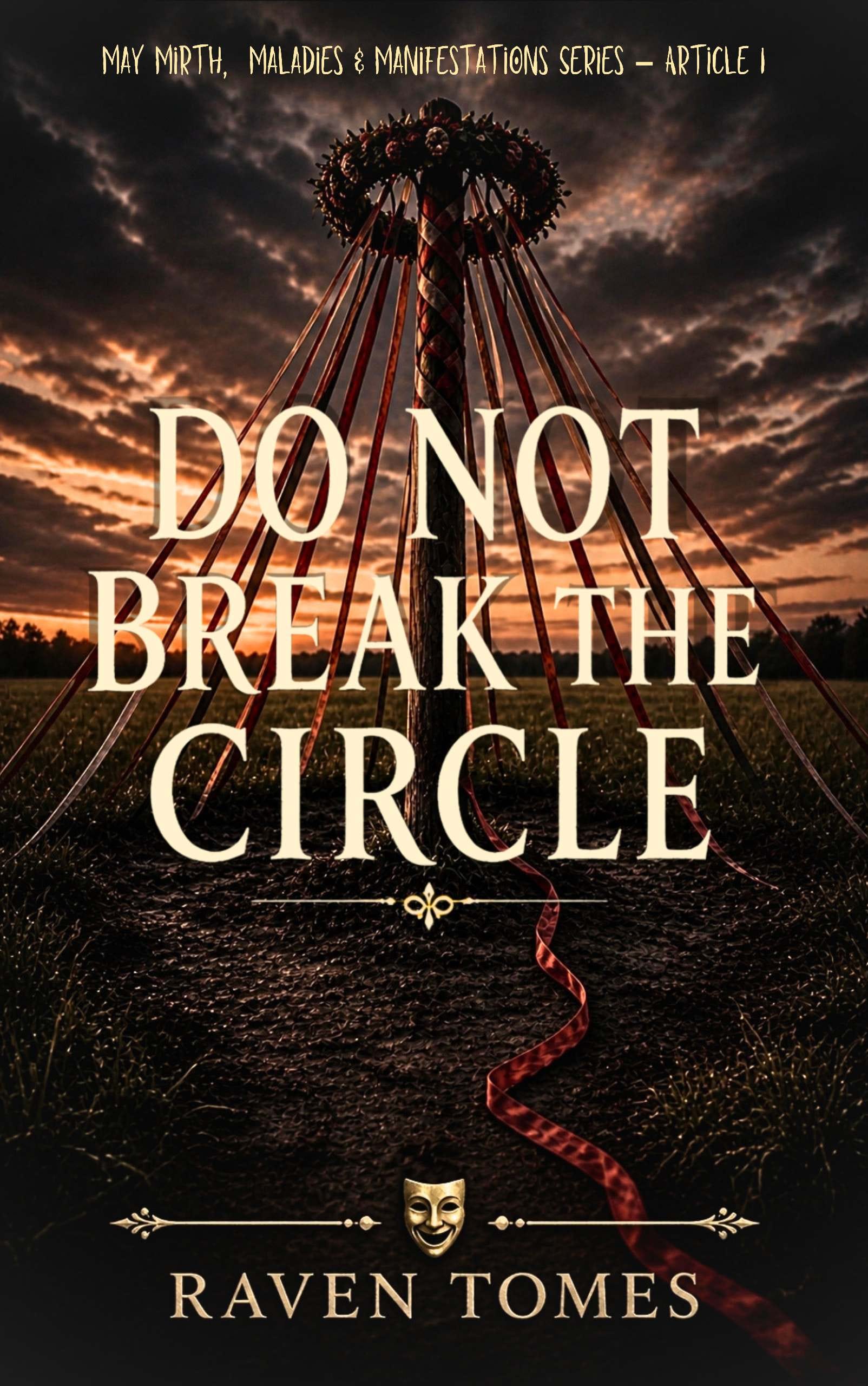
Part of the May Mirth, Maladies & Manifestations Series, where what’s celebrated, what’s suffered… and what’s seen are never the same thing.
By Raven Tomes
Historians will tell you May Day was about fertility. About renewal. About the turning of seasons. They will not tell you why some villages stopped celebrating it altogether.
The field is already prepared before anyone arrives.
The grass has been cut close, though no one in town claims to have done it. The earth beneath it is dark and packed, as if it has been pressed down over years of footsteps that all followed the same path. At the center stands the pole—tall, straight, set deeper than something temporary should be. Ribbons spill from its crown in long, careful lengths, each one clean, each one unfrayed, as though they have been replaced recently.
They always are.
By late morning, the town begins to gather.
Families bring blankets. Children chase one another along the edges of the field, careful not to cross the faint line that circles the pole. It isn’t marked by rope or stone. You only see it if you’re looking for it—where the grass changes, where the ground dips just slightly, where the color darkens as if the soil remembers something the rest of the field has forgotten.
No one steps across it until the music starts.
Visitors come every year.
They hear about the festival the way people hear about anything old enough to sound charming. There’s talk of ribbons and dancing, of tradition carried forward, of a town that has kept something alive when so many others let it go. They arrive with cameras and easy smiles, expecting something quaint.
The town does not discourage them.
“Stay close,” someone says as the first notes of music rise—low at first, carried on a fiddle that sounds older than the hands holding it. “If you’re going to join, you need to stay close.”
It is said like a kindness.
No one explains further.
When the music settles into rhythm, the first dancers step forward.
They move without hesitation, each taking hold of a ribbon as though they already know which one belongs to them. The colors fall into place—reds crossing over blues, yellows slipping beneath greens—forming a pattern that looks simple until you try to follow it with your eyes and realize it never quite repeats the same way twice.
The circle closes.
Only then do the visitors step in.
They laugh as they take the remaining ribbons, adjusting their grip, watching the others for cues. It’s easy enough to follow at first. Step in. Step out. Pass to the left. Turn when the person across from you turns. The music carries them, the rhythm forgiving small mistakes, smoothing over missteps as though it has done this often enough to expect them.
“Don’t let go,” someone says as they pass.
It sounds like advice.
A moment later, another voice, softer this time, closer to the ear:
“Don’t stop moving.”
The instructions come one at a time, offered in passing, never all together, never written down. By the time you realize they’re rules, you’ve already agreed to them.
The dance tightens.
The ribbons begin to weave in earnest now, crossing and looping, pulling the circle into something more deliberate. The pole at the center disappears behind the growing lattice of color, until it looks less like decoration and more like something being bound.
Or something doing the binding.
It is only when the music changes that people notice.
The shift is subtle. The tempo holds, the melody almost the same—but something underneath it drops, just a fraction, like a breath taken too late. A few dancers falter, their steps falling out of time before they correct themselves.
“Don’t look down,” someone murmurs.
This time, it does not sound like advice.
Most people don’t think to question it. There are too many other things to focus on—the steps, the ribbons, the faces passing close and then away again. But one of the visitors does.
She laughs when she hears it, a quick, nervous sound, and glances toward her feet as if to prove there’s nothing there to see.
For a moment, nothing happens.
Then she slows.
It isn’t a dramatic stumble. Not at first. Just a hesitation, a fraction of a second where her step comes late. The ribbon in her hand pulls taut as the person across from her continues forward, forcing her to catch up. She laughs again, apologizing, adjusting her grip.
“I’m fine,” she says.
No one answers.
The music does not change.
But the circle does.
It tightens by inches, drawing her closer to the center without anyone seeming to move differently. The pattern shifts to accommodate her, the others stepping around her hesitation with practiced ease, weaving past her in ways that feel less like correction and more like avoidance.
“Keep moving,” someone says, not unkindly.
She nods, breath catching now, the smile still on her face but strained at the edges. She tries to match the rhythm again—step in, step out—but something has slipped. The timing no longer fits. The space between her and the others feels wrong, as if she is moving through a version of the dance that no one else is following.
“Don’t let go,” the voice comes again, sharper this time.
She looks down.
It is instinct more than defiance. A quick glance, meant to steady herself, to find her footing.
The ground beneath her is not grass.
It hasn’t been, not for a long time.
Where the circle has worn the field away, the soil is exposed—dark, packed, and uneven, marked by shallow impressions that do not match the steps of the dance. They overlap, crossing one another in directions the circle does not move, as if something else has been walking there when no one was watching.
Her step falters completely.
The ribbon slips in her hand.
For a single second, the tension releases.
That is when the music changes.
It drops—cleanly this time, unmistakably—into something lower, heavier, the melody bending into a shape that no longer carries the dance so much as drives it. The others do not stop. If anything, they move more precisely, their steps tightening, their grips firming as the circle closes the space she has left behind.
She tries to catch the ribbon again.
It is no longer where she expects it to be.
The end brushes her wrist as it passes, then slips away, drawn into the weave by hands that do not hesitate. The pattern corrects itself without her, closing the gap, sealing the space she occupied as if it had never been empty.
“Wait,” she says.
No one turns.
The circle continues.
For a moment, she stands at its edge, just outside the line she hadn’t noticed before, breathing hard, one hand still lifted as though she can reach back into the dance if she tries quickly enough.
She steps forward.
The line holds.
It is not visible—not truly—but her foot stops against it as surely as if something solid blocks her way. She presses down, harder this time, but the ground does not give. The music swells, the dancers passing in front of her in a blur of color and motion, their faces turned inward, their expressions fixed in something that is not quite joy.
“Let me back in,” she says, louder now.
The words fall into the music and disappear.
No one answers.
She moves along the edge of the circle, searching for a break, a place where the line thins or fades. There isn’t one. It curves endlessly around the pole, around the dancers, around the space where she had been.
Around what remains.
Because the space is not empty.
It takes her a moment to understand that.
At first, it looks like a trick of movement—the ribbons crossing, the bodies passing in front of one another, creating the illusion of depth where there is none. But as she watches, breath slowing despite herself, she sees it more clearly.
There is someone in her place.
They move in perfect time with the others, their steps exact, their grip firm on a ribbon she can no longer see the end of. Their face turns with the rhythm, passing briefly into view between two others.
It is her.
Not as she is now—standing outside the circle, breathless, hands empty—but as she had been moments before. Smiling. Moving. In time.
Unbroken.
She shakes her head, stepping back, the edge of the field suddenly too close behind her. “That’s not—”
The words die before they finish.
Because the version of her inside the circle does not look at her.
It does not falter.
It does not slow.
It dances.
The music continues.
Around her, the town watches as it always has.
They do not intervene. They do not speak. Some of them do not look at the circle at all, their attention fixed instead on the blankets at their feet, on the children at the edge of the field, on anything that does not require them to acknowledge what happens when the rules are broken.
A few of them do watch.
Their expressions are careful. Measured.
Not surprised.
The dance winds on.
The ribbons tighten, weaving the pole into a column of color that hides whatever stands at its center. The pattern completes itself slowly, inevitably, each crossing locking into place until there is no slack left, no space unclaimed.
Inside the circle, the dancers do not tire.
They do not stumble.
They do not stop.
Outside it, the girl backs away until the line is no longer at her feet, until the field opens up behind her and the sound of the music begins to dull at the edges.
No one follows.
No one calls her back.
By the time the song ends—if it ends—the circle will be complete.
It always is.
Later, when the field is empty again, the pole will stand alone at its center, wrapped tight in ribbons that have been pulled too taut to remove without cutting them away.
No one will cut them.
They will be taken down carefully, unwound in reverse, each length smoothed and set aside for next year.
They always are.
If there is one more than before, no one will say so.
If one of the visitors does not return to their car, or their room, or the place they came from, it will be written off the way these things always are—confusion, poor planning, someone leaving early without telling anyone.
The town will not correct the record.
It never has.
Because the rules were followed.
Or they weren’t.
And the circle does not break for either.
🎭🎭🎭
Some traditions are not meant to be understood.
Only followed.
~~~
Some stories don’t end here. Subscribe before the next one finds you.